 Facebook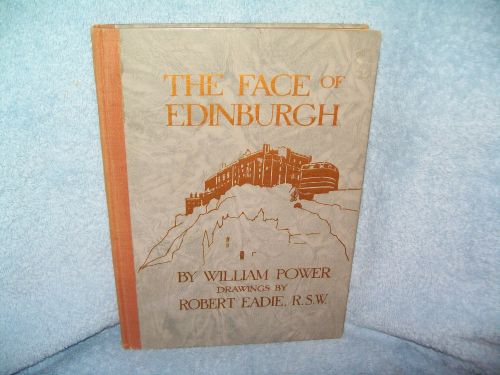
THE FACE OF EDINBURGH
Total In Stock: 1
Contents and Illustrations
The book is a captivating blend of descriptive text and artistic representation, offering readers an intimate glimpse into Scotland’s rich heritage and landscape. The 15 tipped-in drawings by Robert Eadie are particularly noteworthy, each capturing key landmarks and scenic views with an exquisite attention to detail that complements the narrative beautifully. These illustrations serve not only as visual aids but also as standalone works of art, reflecting the author’s deep admiration for the country’s natural and architectural splendors.
Historical and Personal Significance
What adds a unique dimension to this volume are the personal annotations made by the prior owner, J. R. Leng, whose handwritten notes in the margins reveal a reflective and engaged traveler’s perspective. These marginalia provide contemporary insights and emotional responses to the sites depicted, transforming the book into a personal travelogue as much as a historical artifact. Leng’s hope to share these experiences with Alma imbues the book with a poignant sense of longing and connection.
Provenance and Additional Ephemera
The provenance of the book is further enriched by the inclusion of a newspaper clipping dated 30th October1942, concerning the Norwegian Exhibition in Edinburgh. This piece situates the book within a broader cultural and historical context, linking it to wartime events and international cultural exchanges taking place in Scotland at the time. The clipping, together with the owner’s inscription mentioning the close proximity of the purchase to Walter Scott’s former residence, adds layers of historical resonance and personal narrative.
Condition and Collectibility
Despite some wear consistent with its age—such as light edge and corner wear, spine end fraying, and minor staining on the orange cloth spine—the book remains in sound condition, with its binding intact and pages well-preserved. The absence of the dust jacket is typical for books of this vintage, and does not detract significantly from its value. Collectors and enthusiasts of Scottish history, literature, and art will find this volume a valuable addition, both for its content and its evocative connection to a specific moment in time.
Conclusion
In sum, this 1939 publication by John Smith & Son stands as a testament to Edinburgh’s unique allure and the enduring fascination it inspires. Through carefully crafted prose, exquisite illustrations, and the personal touch of its previous owner, the book offers a multifaceted experience that invites readers to appreciate Scotland not only as a place but as a deeply felt cultural and emotional landscape.
John Smith & Son, Glasgow, 1939. Hard cover, 88 pages followed by a fold-out map. Gray marbled boards with gilt lettering and design on front, orange cloth spine with a few small marks and spots. Boards have light edge and corner wear, bit of spine end wear, evidence of sticker removal on upper front board; binding sound. No jacket. Prior owner’s notation on FEP: “Edinburgh, Scotland Nov. 2, 1942. I spent my first 7 day leave in Scotland and saw some of the places shown in the cuts in this book. I bought this book to show Alma where I’d been. Someday I hope to take her where I have been. J. R. Leng. This book was purchased round-the-corner from the home where Walter Scott lived in Edinburgh.” Book contains 15 tipped-in drawings by Robert Eadie. Prior owner has made notations in margins of his impression/observations for various places visited. Laid in is a newspaper clipping from 30th October, 1942 concerning the Norwegian Exhibition in Edinburgh. ‘Of cities possessing a total organic beauty, like that of a fine tree or mountain, there are few. … Edinburgh differs from all these. … To portray Edinburgh is far beyond my powers. I have confined myself to an analysis of some of the elements that go to make up its complex yet so marvellously unified charm.’ (from Homage to Our Capital)