 Facebook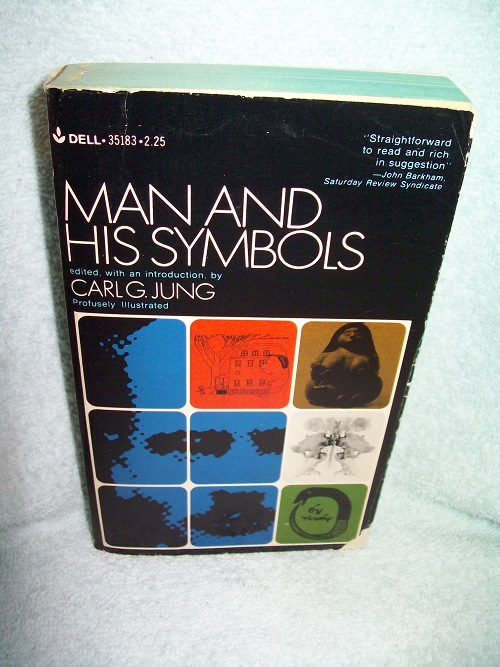
MAN AND HIS SYMBOLS
Total In Stock: 1
Dell, New York, 1978, 17th pr. ISBN 0-440-35183-5. MMPB, 415 pages including Notes, Index, Illustration Credits, and about Carl G. Jung. Good; wraps show edge and cover wear, creases and reading creases, wear at corners and spine ends, small loss to cover photo at lower front corner; binding sound. Interior clean and unmarked with tanned pages; black & white photos and drawings. ‘”This book, which was the last piece of work undertaken by Jung before his death in 1961, provides a unique opportunity to assess his contribution to the life and thought of our time, for it was also his first attempt to present his life-work in psychology to a non-technical public … What emerges with great clarity from the book is that Jung has done immense service both to psychology as a science and to our general understanding of man in society, by insisting that imaginative life must be taken seriously in its own right, as the most distinctive characteristic of human beings.” – Guardian’ (from rear wrap)
Overview and Significance
This volume stands as a pivotal work in the field of psychology, capturing the essence of Carl G. Jung’s profound insights into the human psyche. As Jung’s final scholarly contribution before his passing in1961, the book offers readers not only a comprehensive overview of his theories but also an accessible narrative intended for a broader audience beyond academic circles. Its importance lies in bridging the gap between complex psychological concepts and everyday understanding, making Jung’s ideas relevant to both specialists and lay readers alike.
Condition and Presentation
The physical condition of this edition reflects its history as a well-used and cherished text. The wraps exhibit edge and cover wear, including creases and minor damage at the corners and spine ends, which attest to its extensive use. Despite these external signs of wear, the binding remains sound and intact, ensuring the book’s durability for continued reading. Inside, the pages are clean and free from markings, with a natural tanning that adds to the vintage character of the book. The inclusion of black and white photographs and drawings enriches the reader’s experience, providing visual context to Jung’s theories and life.
Content Highlights
The text itself delves deeply into Jung’s exploration of the imagination as a fundamental aspect of human nature. His insistence that imaginative life deserves serious consideration challenges traditional scientific paradigms that often dismiss subjective experience. Through detailed notes, an extensive index, and carefully credited illustrations, this edition supports a thorough and engaging study of Jung’s legacy.
Critical Reception
As noted in the Guardian’s review on the rear wrap, Jung’s work is recognized for its immense contribution not only to psychology as a scientific discipline but also to our broader cultural understanding of humanity. His emphasis on the imaginative life as a defining trait of human beings invites readers to reflect on the richness of inner experience and its impact on society. This perspective continues to influence contemporary thought in psychology, philosophy, and the arts.
Who Should Read This Book?
This book is ideal for students and scholars of psychology, as well as anyone interested in the intersection of science and the humanities. It is especially valuable for those seeking to understand the historical development of psychological ideas and their application to real-world human experience. Additionally, readers with a curiosity about Carl G. Jung’s personal journey and his role in shaping modern thought will find this edition both informative and inspiring.