 Facebook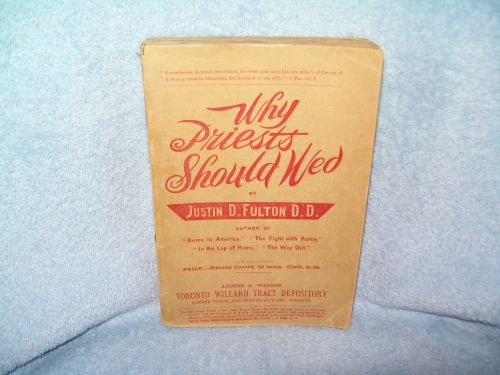
WHY PRIESTS SHOULD WED
Total In Stock: 1
Overview and Historical Context
This volume from the Toronto Willard Tract Depository offers a rare glimpse into late 19th-century religious and social critique, particularly focusing on the Roman Catholic Church. Published in 1889, the text reflects the era’s contentious discourse surrounding religious authority, gender dynamics, and moral concerns. The author’s pointed observations, as highlighted in the preface, underscore the perceived dangers faced by women and girls within certain religious institutions—a topic that resonated deeply in many communities grappling with questions of faith, power, and societal norms.
Physical Description and Condition
The softcover edition, measuring approximately 339 pages, features card covers accented with red lettering on both the front and spine. Despite its age, the book remains largely intact, though it exhibits typical signs of wear such as edge scuffing, minor staining, and several creases and short tears that have resulted in small losses along the margins. Notably, the front endpaper bears the previous owner’s inscription, adding a layer of provenance and personal history to the volume.
The black and white frontispiece portrait of the author remains protected by its original tissue guard, a testament to the care taken in preserving the book’s presentation. However, certain pages show imperfections likely stemming from the original printing process—such as a blemish on page 6 affecting a portion of the text, and an apparent bleaching flaw on page 173. Additionally, pages 330-331 are darkened due to prolonged contact with an inserted item.
Typography and Illustrations
One of the more distinctive features of this edition is its use of illustrated frames enclosing all text blocks, which lends the pages a decorative and somewhat formal appearance. The black and white illustrations scattered throughout the volume provide visual context and reinforce the themes discussed, serving as both informative and aesthetic enhancements to the written content.
Binding and Durability
While the binding shows signs of stress with cracks in several spots, all pages remain securely attached, ensuring the book’s usability for readers and collectors alike. Given the volume’s age and wear, this condition is quite remarkable and attests to the quality of materials and craftsmanship employed during its production.
Significance and Legacy
This publication stands as a compelling historical artifact, reflecting the complex interplay between religion, social critique, and gender politics in the late 19th century. Its candid commentary on the role of the Roman Catholic Church and its clergy invites readers to examine the broader societal implications of faith and institutional authority during a period marked by significant cultural and ideological shifts.
For historians, bibliophiles, and scholars of religious studies, the Toronto Willard Tract Depository’s 1889 edition offers valuable insights into the tensions and debates of its time. It serves not only as a document of religious polemic but also as a window into the lived experiences and anxieties of communities navigating issues of morality, power, and identity.